Showing posts with label preston county. Show all posts

Thursday, April 24, 2008

[trip] Hero Hole Survey

This Thursday evening, April 24, 2008, Brian Masney, Abby Hohn, and I headed into the Cheat Canyon to survey Hero Hole. This cave hasn't been visited since it was dug open on New Years Eve 2005/2006, and we expected the mined "sinkhole" entrance to have slumped closed. We arrived at the cave around 7PM with a full cache of digging and surveying gear. Abby headed down to the bank of the Cheat River to study, while Brian immediately jumped in and started hauling rocks out of the entrance. There was a strong, cool breeze blowing out, and there were plenty of loose rocks above the entrance in addition to a great deal of washed-in mud and rock. After roughly an hour, we had cleared the passage out and geared up to head underground.


You have never truly caved until you have caved in the Cheat Canyon. Re-digging into Hero Hole, upsidedown. Photo by Brian Masney.

After climbing down the dug entrance hole, you drag yourself under a shelf across a silted "beach" bellycrawl which "opens up" to a small 4-foot-high room. The cave stream seemed lower than I remember it, and looking downstream to where the stream follows an impassibly-small conduit, we saw Hero Hole's namesake, Hero Man, battered and beaten by the harsh cave environment, stripped practically naked and lying in the stream. Not wanting to wind up with a similar fate, Brian and I wasted no time in heading all the way upstream, so that we could survey from the back out. The main cave passage ends where the cave stream emerges from a channel which is too tight to follow; the ceiling height is no more than 3 feet, and the width certainly less than that. Given the cramped, wet, conditions, and the fact that we were doing a two-man survey, it was a slow operation. The canyon passage meanders a bit, and protrusions and shelves composed of patented Druid CrapRock™ poke out here and jab there.

By the time we were at the halfway point, Brian suddenly became extremely cold... his survey station was directly under a tiny conduit at ceiling level, no more than 6 or 8 inches wide, where the chilling wind blasts out. If there is any hope for Hero Hole, it is by following the air up into this "lead". Beyond this air duct was a truly miserable stream crawl, where the dipping ceiling forces your head progressively lower and lower. Luckily, in such a short cave, the halfway point means that you're almost finished! Before long, we were on the surface, soaked, slimed, and chilled from the cave's wind. We were underground for less than two hours, and managed to squeeze 100.5 feet out of Hero Hole! By midnight, we were on our way back out of the Canyon, satisfied with another great day of trying to piece together the Druid Cave System puzzle.


Hero Hole plan-view lineplot, with a surprising 100.5 feet of survey.

Sunday, April 13, 2008

[trip] Briery Mountain Weekend

This weekend I assisted John Chenger with relocating and exploring several caves in the Briery Mountain area of Preston County in order to look for bats. We met at noon on Saturday, April 12, in Kingwood. I loaded my gear into his truck, which was equipped with a GPS and laptop showing our live location on a topo map, and we headed off.

Our first stop was Briery Mountain Pit, which we easily found in a large sink on the side of the road. A culvert feeds water into the sink, which falls 25 feet and then sinks as a spraying waterfall into the cave's entrance. We rigged a cable ladder, but I found that I was able to free-climb the 10 foot deep entrance pit - a 2 foot wide vertical slot - without getting too wet. Once down in the 8 foot high entrance passage, you must dart back under the waterfall to continue; nothing like getting soaked on the way into a cave! The cave consists of a couple-hundred feet of walking and stooping passage, stream passage that zigs and zags across joints, with occasional dead-end side leads. The floor was extensively littered with broken glass, cans, plastic, and all sorts of washed-in debris. The walls and ceiling were covered in a thin layer of filth, the rock of questionable character, and there was silt and mud caked into every corner. The strata dips 10 to 15 degrees back into the hillside (under the road) and it's difficult to walk very far before something new drips onto your head. I eventually came to a 4 foot tall, 12 inch wide vertical slot where the stream disappeared into; a squeeze that I was warned about by veterans of the cave, and I decided at that point that I'd seen enough of Briery Mountain Pit. Bat count: zero.


That water was cold! Climbing down into the entrance of Briery Mountain Pit. Photo by John Chenger.

Unfortunately, John was feeling rather ill at this point, and with my cave gear entirely soaked, we decided to call it a day. He got some rest, and I headed back home to Morgantown, where I had just enough daylight left to dry out my cavesuit and do a bit of rock climbing. I received word in the morning that John felt much better, so we met in Bruceton Mills at noon on Sunday and set off for a second day of Preston County caving.

First up was Kelly Quarry Cave, a cave which literally stunk... Located in the walls of an old quarry, this cave appears to be formed in the Savage Dam member of the Greenbrier, a series of sandy limestones and red shales, and in the top of the Loyalhanna. We both entered the Kelly Quarry Crawl entrance, the right-most and highest entrance, which consisted of a body-sized crawl through a rather odd passage for the area: the walls are coated with a 2 inch thick crust of Aragonite, some of which has had popcorn deposited on the ends. Sadly, all the crystal is stained an unflattering mud-brown color. This passage continues as a small crawlway for around 75 feet until a junction is reached (with air), which was too small for even me to fit through. With considerable effort, I was able to turn myself around, and we both crawled back out to check out the other entrances. The main entrance and second entrance are stacked on top of each other. Flowstone is visible above them, and there are slickenslides on some of the exposed rock. The fractured limestone, probably unstable from quarrying, has collapsed these main entrances, and one cannot enter the "largest room" in the cave without crawling through some very sketchy-looking breakdown. We chose not to push our luck, and did not enter these collapsed entrances. Bat count: zero. Dead skunk count: two.


Aragonite crystal in Kelly Quarry Cave. Photo by John Chenger.


The collapsed main entrances of Kelly Quarry Cave. Photo by John Chenger.

As we were heading away from Kelly Quarry Cave and "ridge-driving" the area, we spotted what appeared to be a pit on the side of the road. Sure enough, it was a 6 foot diameter sink filled with karsted limestone chunks, with a roaring stream audible down below - John dubbed it the Roaring Rift as I climbed down 15 feet into tall and narrow virgin stream passage. After scooping around 250 feet of walking passage in cleanly-sculpted Loyalhanna limestone, the ceiling narrowed, and I decided to save the remainder for a future survey trip. This is surely an area in need of ridge-walking, and it was quite a treat to find virgin walking passage in this county - a personal treat for me because it was my 100th cave! As you would expect, this un-planned cave had the highest bat count of the weekend, eight pips.


Climbing down into the "roaring" stream passage below upon discovering Roaring Rift. Photo by John Chenger.

Just a short distance from this new cave, we spied an abandoned mine which wasn't marked on the topo map, which John called Roaring Run Mine. We decided that it probably wasn't limestone, but headed in to investigate. While we didn't find many bats (only two), we did find an unexpected resident: a quail or pheasant who didn't appreciate our headlamps pointed at her.


Roaring Run Mine, in obviously dipping strata. Photo by John Chenger.

Continuing on to the last cave on our list, we headed to the tiny town of Orr to find Orr Cave. We spent a great deal of time just trying to find some limestone, let alone the "shallow sink" that Garton describes. Eventually, on our way back to the truck, we finally located the entrance hidden in a small outcrop and covered with a few logs. I climbed down in and started crawling... on my side... in water... until the cave ended in a drippy dome. While this is an area that should be looked at (we saw a few very interesting springs on the way), Orr Cave is not one that I plan on visiting again. Bat count: zero.


Recording data at the entrance to Orr Cave. Photo by John Chenger.

After parting ways with John, I headed South for Thomas, where I met a group of cavers at the Purple Fiddle to hear Doug McCarty play some amazing music. The drive home was interesting, as the Spring weather turned back into Winter, and the roads were covered with snow and sleet. Overall, it was a fantastic weekend caving in a rarely-visited part of Preston County.

Sunday, September 02, 2007

[trip] Windy Slope Dig

Sunday morning of OTR, at what seemed like the crack of dawn, I groggily heard Brian Masney and Doug McCarty pack up and head North for the Cheat Canyon. Aaron Bird and Bob Kirk were apparently already on their way to finish digging and start surveying in our newest Cheat Canyon cave; I closed my eyes and went back to sleep. Eventually I managed to drag myself out of bed, pack up camp, and drive 1.5 hours to Masontown. As expected, when I arrived everyone was already down in the canyon, leaving me no choice but to pack up all my caving gear into a backpack and start hiking all the way down into the Canyon - ugh. Luckily, as I started my hike, a speeding pickup truck came flying down the road, beer cans clanking and music cranked - they shouted "hop in, buddy!" and hauled me all the way down, 45 minutes by 4WD truck, saving me what would have been an even longer hike.

I finally arrived at the Windy Slope Cave entrance, much to the surprise of the large group of cavers milling around outside. Bob and Aaron were inside digging on the squeeze in the Fichtner Entrance, while Doug, Brian, Sandy, Greg Springer, and Terry "Monk" McClanathan waited outside. Much time passed, and Aaron, Doug, and I killed some time by digging on a hole upriver and directly across the river from Spring Falls Cave (which didn't yield anything major to us). Meanwhile Greg and Brian were inside digging, Greg being frustrated enough to trudge through the icy cold Water Entrance by himself.


Dedicated team of diggers and surveyers, who traveled from as far as Ohio, Baltimore, or Michigan for a taste of sweet Cheat Canyon caving. L-R: Doug McCarty, Aaron Bird, Bob Kirk, Sandy ?, Greg Springer, Dave Riggs, Terry McClanathan and Brian Masney. Photo by Bob Kirk.

After several hours, enough progress was made on the dig so that everyone could fit through the squeeze. I started in and was informed that surveying had been nixed for the trip. I took Terry and Sandy for a tour of the cave, then Terry and I went out the Water Entrance to give him the "full taste" of a Cheat Canyon cave. We hiked down the hill and waded into the bath-water-warm Cheat River in full cave gear, washing everything off and staining the entire river brown. With zero feet surveyed, we hiked up to the vehicles and drove out of the canyon - despite lots of traffic on the Druid Road - for a Mexican dinner.

Saturday, June 23, 2007

[trip] Windy Slope Cave Dig

I did a podcast trip report from our digging trip into the newest significant cave in the Cheat Canyon, Windy Slope Cave. You can listen to the 15 minute report on PodCaver.

We got to explore the largest passage discovered in the Canyon since New Years Day Cave, and it goes for well over 1000 feet. Our digging efforts paid off - I was able to make the first ever through trip from the Fichtner entrance to the water entrance of Windy Slope Cave.

Link: Windy Slope Dig PodCast


Dave Riggs, Brian Masney, and Doug McCarty in front of the Wet Entrance of Windy Slope Cave. Photo by John Harman.

Friday, June 08, 2007

[trip] Cheat Canyon Work Week Day 1

Today was the first day of the Cheat Canyon work week, and it's already been productive. We met around 9am at IHOP for breakfast, and were greeted with an inspiring phone call from Allen Peterson. Allen's luck for finding cave in the canyon has apparently rubbed off on us (yes, bad luck is communicable). We arrived at Mark's farm by 10:30, and Brian drove us down into the canyon by 11am. From here, we split into two teams.

Aaron and Tristen Bird, Greg Springer, and Doug McCarty headed to the new cave above the Twin Springs with the goal of enlarging the blowing lead. The cave has now been named Fichtner Cave, in honor of a great landowner who has really helped us to make progress in the canyon. Edit: The cave became the Fichtner Entrance to Windy Slope Cave.

Aaron and Doug modified some tight rock using a Hilti loaned from Rocky Parsons and the Shavers Mountain Survey - Doug preferring to create significant clearance with just a hammer. They say that just a few feet of easily-scooped silt keeps them from reaching the room at the current end of the lead. Wind howls through this passage and room.

Meanwhile, Greg walked down the hill to river level, headed upstream for less than 100 yards, and hiked up a small gully which seemed to be blowing a slight cool breeze. About 50 feet up - perhaps 10 feet lower in elevation than the nearby Fichtner Cave entrance - he pulled up a rock and was hit with a "geyser of cold air". He and Aaron dug a bit and were soon looking down the barrel of more virgin cave! Aaron crawled in the entrance hole, turned towards Fichtner Cave, and was standing in a pool in walking passage. The passage ranges from 4 to 6 feet high, 1.5 to 3 feet wide, and is completely full of water - waist-deep at its deepest. He scooped about 60 feet to verify that it goes (it goes!) and headed back out, soaked and slimed. This cave also blows cold air with serious velocity, and it is suspected to be a lower level (and second entrance) of the nearby Fichtner Cave. The gully had been inspected by everyone at one point in the past, and had previously been flowing with considerable water, but was nearly dry today. This cave will be surveyed on Sunday.

While the other group was popping rocks and scooping virgin cave, Brian and I - Dave Riggs - went to push and survey the new cave that was dug open with Allen Peterson earlier this week. Allen has aptly named the cave Original Sin Cave, because finding and digging on this karst spring in 1980 was "The Original Sin" which has doomed generations of Northern WV cavers to spend an eternity in hellish Cheat Canyon caves. Dressed only in wetsuits, kneepads, knee-high rubber boots and helmets, Brian and I became known for the day as the "Extreme Team".

I headed into the cave first, and immediately noted that the entrance pool - dubbed by us "The Hot Tub" - was much lower than it was on Monday, excellent news! We both pushed our way back into the cave to the tighter spot where I'd previously turned back. A few rocks were moved, and I was beyond and caving in soggy virgin passage again... at least, for a few tens of feet. About 100 feet in, the cave stream comes in from a parallel side passage on the right; a ledge here provides only about 7 inches of crawl space to get past. It appears that if some cemented rocks were hammered from the floor, a small caver could push beyond and follow the water upstream where it appears to open up slightly more. The passage that we were in was never more than 2 feet tall or 3 feet wide, and we were constantly in icy water. There were a few small stalactites on the ceiling, however.


Dave Riggs in monotonous 18-inch-high stream passage, Original Sin Cave, Preston County WV. The stream is perched on a layer of black shale, visible at the bottom of the cave walls. Photo by Brian Masney

We headed out to warm up and eat, then did a bit of surface examination now that we knew what the cave inside did (but found nothing but sandstone talus on the canyon wall). We then surveyed the cave - a painful effort with a two-man team laying in an icy stream in 18 inch high passage. On the way out, we noted that the Hot Tub was very noticeably deeper than it was in the morning, and we suspect that this cave may flood to the ceiling at times.

Then, almost instantly, the sky turned grey and rain poured from above. We radioed the other group, who shared their news of another new cave, and headed across the canyon to see. We arrived as they were packing up, rain still coming down. Brian drove us back to Mark's house by 6pm, where the thunderstorm raged. Not wanting to camp in the rain, everyone decided to sleep in Morgantown for the night. We meet again tomorrow morning, 9am at Mark's house.

Work Week Stats
Surveyed Cave: 96'
New Caves: 1
Virgin Cave: 110'
Participants: 5
Person Hours Worked: 30
Beers Consumed: zero!

Monday, June 04, 2007

[trip] More Virgin Cave in the Cheat Canyon

Nearly 30 years ago, Allen Peterson and his band of "druids" did some ridge walking on the South side of the Cheat River canyon and discovered an interesting karst spring below an old logging road. They very briefly dug on the spring before following its water downhill, leading to the discovery of Druid Cave. As Druid grew over the years to 2.3 miles in length, the spring above its entrance was forgotten... until dye tracing in 2007 showed that this spring plays a very interesting hydrological role in the Druid Cave system: it appears to be the downstream resurgence of New Years Day Cave, which appears to be hydrologically distinct from Druid Cave until this spring water flows into the Druid Cave entrance on the surface.

Today, Brian Masney and I met up with Allen Peterson and revisited this karst spring for the first time since the discovery of Druid Cave. Allen, in the area for a business trip, met me at the Pittsburgh airport and drove us down to Morgantown. After meeting up with Brian, shuttling vehicles around, and fighting with car problems, we were off to Masontown and started hiking down into the canyon at around 2:30pm.

On arrival, we immediately started digging in to the spring, which fanned out both horizontally and vertically along the hillside below a limestone headwall. I prodded at a small conduit with a crowbar, while Brian and Allen poked around some large moss-covered breakdown with water flowing from within. Allen moved several rocks aside and felt a strong, cool breeze - paydirt! We went at the area with our hand tools and found that this part of the hillside was completely composed of breakdown blocks, small rocks, and easily movable fill. Over the next several hours, we easily moved close to a ton of rock - exposing more airflow and a cave stream, and destabilizing some of the sketchier rocks on the hillside.

The cave passage visible inside was low and very wet; working conditions required sliding downhill and pulling rocks out while someone else tugged you out by your own boots. We spent some time stabilizing the lining rocks and removing most of the entrance slope. The only remaining barrier was the icy-cold soaking in very low, unknown passage. We all took turns trying to push the nasty entrance, but none of us made it on first attempt. Brian and I played rock paper scissors, and I lost, so I took a deep breath and scooped some nasty, wet, virgin cave.


Dave Riggs emerges soaked from the low, wet, newly dug cave above Druid Cave. Photo by Brian Masney.

The entrance pool is a six foot wide chamber where the swiftly-moving cave stream is between two and six inches deep, and air space is one foot at the highest point. A wetsuit is needed from the very start, as the water is extremely cold and one is entirely soaked immediately.

Following the cave stream to the right, one travels parallel to the Cheat River, and distinctly up-dip in a nearly-straight line. The cave passage is never more than three feet high or wide, and is a semi-circular arching stream passage. The cave stream, while only an inch or two deep, takes up the entirety of the width of the passage in most spots, and is perched on a layer of etched black shale. I continued for what seemed like seventy-five feet, until the cave passage became small enough that I'd have had to exert real effort to continue, but the airflow and water ensure more cave beyond - so long as one has a wetsuit.


Brian Masney, Dave Riggs, and Allen Peterson at the newly dug cave entrance above Druid Cave. Photo by Brian Masney.

After all these years, the very first karst feature discovered by Druid Cave explorers finally yields virgin cave to one of its original discoverers. The dye tracing results show that this new cave should be the hydrological downstream resurgence to New Years Day Cave, and the fact that it appears to be perched on a shale bed reinforces the implication that New Years Day Cave and Druid Cave are hydrologically distinct, parallel caves.

The Druid Cave saga continues...

Wednesday, March 14, 2007

[trip] Beaverhole Upper

Rather than suffer through another grotto meeting on a perfectly good Wednesday night, the WVU Student Grotto opted to go caving instead. Gayle Suppa, Jessica Powell, John Neubert, Tom Lilly, Chris Eleyette, John Harman, Kyle McMillan, and Dave Riggs met at 5:30pm and carpooled down into the North side of the Cheat Canyon. John Harman seemed disappointed that the old logging road didn't give his Jeep enough of a workout.

We had excellent weather, and thanks to the new daylight savings change, we had plenty of daylight. After gearing up and hiking a bit down the road, we snapped some obligatory photos and then headed into Beaverhole Upper Cave. Half the group decided to take the high-and-dry big upper passages, while the other half preferred the low-and-wet nasty sewer passage instead - to each his own, I suppose. After exploring the back half of the cave, our groups finally met back up in one of the larger junction rooms.

Making its debut on this trip was Kyle's new "cave radio", a low frequency wireless radio from the mining industry. This beast is the size of a full backpack, weighs probably 25lbs, and has a 4 foot long PVC antenna which needs to be carried with it. Several poor souls got volunteered to help carry this radio into the cave for its maiden broadcast. Unfortunately, we were never able to successfully carry a transmission from within the cave, and then Kyle made a "terminal adjustment" to the antenna, abruptly ending the experiment.

We headed back outside, collected a bag of trash from around the cave, and then climbed back up to the road. On our way back up, a sketchy-looking Jeep came down the road at us - Rich Finley and Jason Thomas had arrived just in time for dinner. Rich tried to impress us by doing a terrifying hill climb, but John one-upped him by doing the climb in reverse! We made it back to Morgantown by 10:30pm and had a pancake feast at IHOP. It was a very fun evening trip - much better than a grotto meeting!

Sunday, March 11, 2007

Cheat Canyon Dye Retrieval Pt. 2

Today John Tudek, Tom Lilly, and Dave Riggs hiked into the Cheat Canyon to pull dye traps and examine some interesting karst features along the way. We met at 10:30am in Morgantown, then drove out to the NYDC-area landowner's house. We immediately set out for what would be a beautiful day - "warm" temperatures in the high 40's, and not a single cloud in the sky all day. The sun had nearly melted all the snow in the canyon by midday.

We hiked down from his farm, then headed upstream all the way to the Downstream Dig, stopping only briefly for a few photos on the way. The cave itself was still iced shut, so we quickly retrieved and replaced the dye trap in the spring and moved on.


Tom and John examine Hanging Falls, upstream from the Downstream Dig.

The next stop was the twin springs at river level. When we finally arrived, the springs themselves were completely underwater and not visible from the shore. Unfortunately, the Cheat was much higher during the last two weeks - at least three feet higher than normal level, as evidenced by debris lodged in trees and shrubbery close to the shore. Among the debris were our two dye traps - one left up on the shoreline, one was tangled and hanging up in the trees! We retrieved and replaced the traps, this time tying rocks to the string to serve as anchors. Hopefully they were in the water when (if) the dye passed through the springs.


Dye trap suspended about three feet in the air after a flood event.

We also spent some time enlarging the sucking hole located about 30 feet above these springs. We made short work of several hundred pounds of fractured limestone, exposing a larger hole which still howls air into it. This hole may have some serious promise. We hope to return soon when the ground is less frozen and digging is easier.


The enlarged sucking hole with glove for scale.

We then made the long hike back out of the canyon, arriving at the rim of the gorge at 4:30pm. Now that all the dye traps have been collected, we're all waiting impatiently for the results - hopefully we'll prove a hydrological connection between New Years Day Cave and Druid Cave!

See also: more photos by Dave Riggs

Friday, March 09, 2007

[trip] Druid Cave Dye Retrieval

To take advantage of the 50-degree heatwave today, Brian Masney and I decided that we'd head into Druid Cave to recover the dye traps place there just two weeks ago. We met at about 2:30pm on Friday afternoon, then carpooled in Brian's truck to the Cheat Canyon. Morgantown was very recently hit with a sudden blast of snow, so we were worried about the amount remaining in the canyon despite the temporary warm temperatures.

Brian drove his truck down the start of the Druid road, and we slid down the entire length of the first hill - yikes! Brian hopped out, quickly installed chains on his front tires, then tested things out by running back up and down the hill - a huge improvement! Despite several inches of snow, he drove us all the way down to the cave without incident.

We geared up and made it to the Druid Cave entrance at about 4pm. We were "greeted" by an odd bat, who flew out the main entrance and did some laps around the area for a bit, before we'd even entered the cave. The two of us headed into the cave, rigged the main drop, and rappelled the first drop with the welcome help of a webbing etrier.

Not wanting to make an expedition of the trip, we wasted no time in moving through the cave. We barreled through the high & dry canyon passage, then rappelled the second drop. Both armed with foot ascenders, we made short work of the waterfall ascent (which did not seem to have increased in flow at all, even with a large amount of snow melt this week) and the climb-ups.

At the walking stream passage, Brian stayed behind to try and photograph the sleeping bats, while I headed forward to the Big Nasty to retrieve the dye traps. I made sure not to handle the dye traps themselves, but rather only the strings, and I individually double-bagged and labeled each one. They were hauled out of the cave in a hard plastic container. Like the previous waterfall, the Big Nasty did not appear to have a higher water level than it did two weeks prior.

The trip back out was business-like and without incident. Except for the "special" bat when we arrived, none of the others were disturbed by our visit. Amazingly, we managed to do the entire trip in just under 2.5 hours, catching a glimpse of daylight as we exited the cave. Brian hauled us back up and out of the canyon, and we were back in town and eating a great dinner at Black Bear by 8:15pm.

We plan to hike back into the canyon this Sunday to pull the rest of the dye traps and investigate some interesting new karst features that were discovered recently.

Wednesday, November 08, 2006

[trip] Beaverhole Upper

After a day of brutal ridge walking in the Cheat Canyon, I met up with John Cunningham, John Tudek, and first-time caver Nicole Bodkin at 5pm. We drove down through Pisgah and into the Cheat Canyon, geared up and headed into Beaverhole Upper Cave. There was no shortage of water flowing through the cave this evening; the back passages had insurging water pouring down from the ceiling and infeeder crevices, the back side was full of leaves and sticks. On the way out, I discovered a brand new room which John T noted as looking suspiciously identical to the previous room.

Afterward, noting all the washed-in debris in the back of the cave, we tried to find the insurgence point in the stream down the road, but the dark and the abundance of leaves on the ground kept it hidden from us. We were back home at 9:30pm. Everyone had a good time and Nicole is eager to go caving again soon.

Monday, June 12, 2006

[trip] Biology Study

Bob Griffith and I helped Dr. Daniel Fong and Dr. Horton Hobbs on a biology study this week, cataloguing invertebrate cave fauna. We took them to Beaverhole Upper, Maiden Run #2, and Maiden Run #1 on Monday, then to Beaverhole Lower on Tuesday. I'm now an honorary vertical biologist.


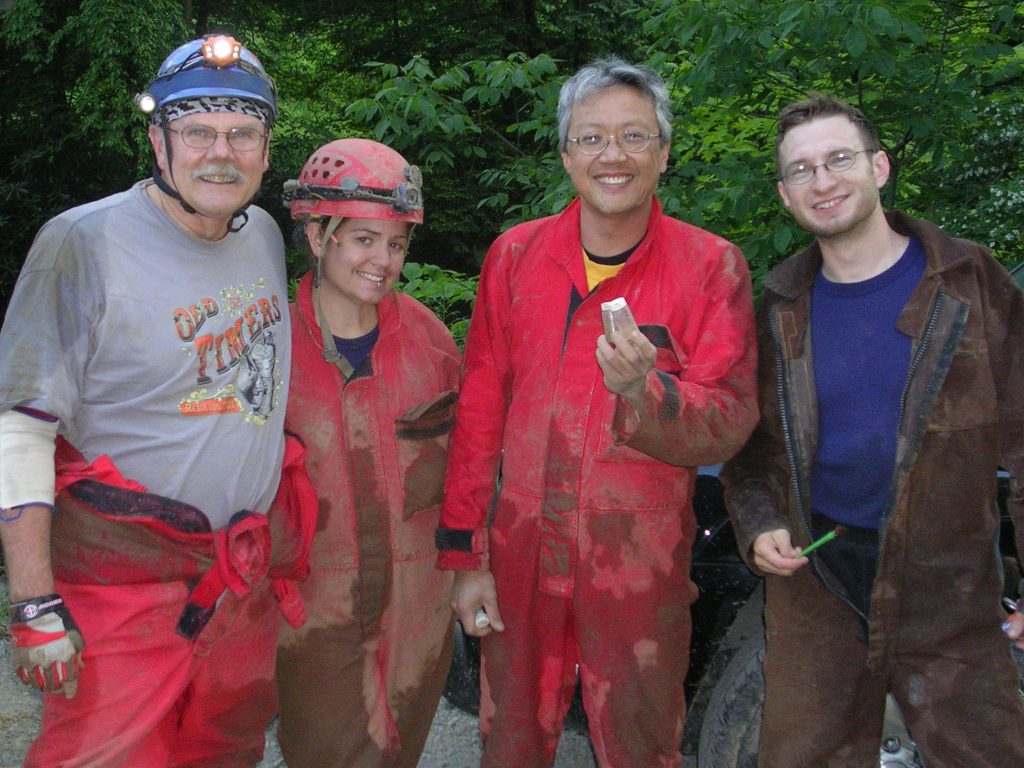
Horton Hobbs, Katie Schneider, Dan Fong, Dave Riggs