Showing posts with label cheat canyon. Show all posts

Thursday, April 24, 2008

[trip] Hero Hole Survey

This Thursday evening, April 24, 2008, Brian Masney, Abby Hohn, and I headed into the Cheat Canyon to survey Hero Hole. This cave hasn't been visited since it was dug open on New Years Eve 2005/2006, and we expected the mined "sinkhole" entrance to have slumped closed. We arrived at the cave around 7PM with a full cache of digging and surveying gear. Abby headed down to the bank of the Cheat River to study, while Brian immediately jumped in and started hauling rocks out of the entrance. There was a strong, cool breeze blowing out, and there were plenty of loose rocks above the entrance in addition to a great deal of washed-in mud and rock. After roughly an hour, we had cleared the passage out and geared up to head underground.


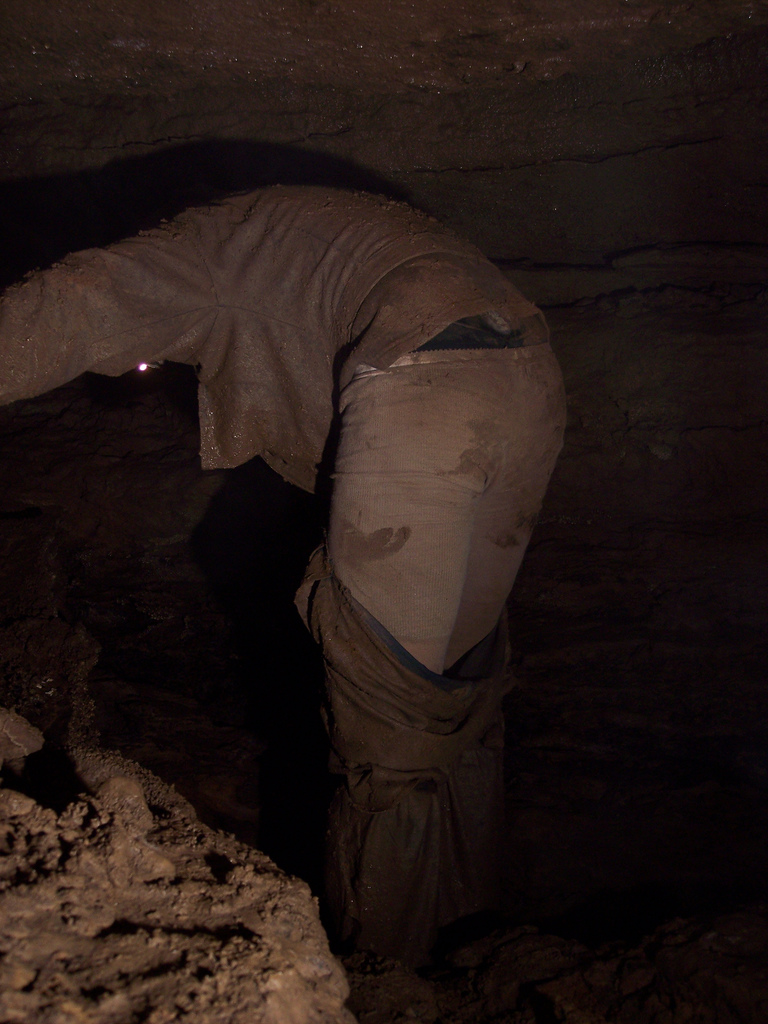
You have never truly caved until you have caved in the Cheat Canyon. Re-digging into Hero Hole, upsidedown. Photo by Brian Masney.

After climbing down the dug entrance hole, you drag yourself under a shelf across a silted "beach" bellycrawl which "opens up" to a small 4-foot-high room. The cave stream seemed lower than I remember it, and looking downstream to where the stream follows an impassibly-small conduit, we saw Hero Hole's namesake, Hero Man, battered and beaten by the harsh cave environment, stripped practically naked and lying in the stream. Not wanting to wind up with a similar fate, Brian and I wasted no time in heading all the way upstream, so that we could survey from the back out. The main cave passage ends where the cave stream emerges from a channel which is too tight to follow; the ceiling height is no more than 3 feet, and the width certainly less than that. Given the cramped, wet, conditions, and the fact that we were doing a two-man survey, it was a slow operation. The canyon passage meanders a bit, and protrusions and shelves composed of patented Druid CrapRock™ poke out here and jab there.

By the time we were at the halfway point, Brian suddenly became extremely cold... his survey station was directly under a tiny conduit at ceiling level, no more than 6 or 8 inches wide, where the chilling wind blasts out. If there is any hope for Hero Hole, it is by following the air up into this "lead". Beyond this air duct was a truly miserable stream crawl, where the dipping ceiling forces your head progressively lower and lower. Luckily, in such a short cave, the halfway point means that you're almost finished! Before long, we were on the surface, soaked, slimed, and chilled from the cave's wind. We were underground for less than two hours, and managed to squeeze 100.5 feet out of Hero Hole! By midnight, we were on our way back out of the Canyon, satisfied with another great day of trying to piece together the Druid Cave System puzzle.


Hero Hole plan-view lineplot, with a surprising 100.5 feet of survey.

Saturday, November 17, 2007

[trip] Cheat Ridgewalking Yields New Small Caves

Finding ourselves bored with this month's Tucker County survey canceled, Brian Masney, John Harman and I decided to do some ridge walking and surveying in the Cheat Canyon. While we never managed to survey the cave we'd intended to, we did find a few new small caves, and... play a bit of football?!

When we drove down the North rim of the Cheat Canyon, we found the Beaverhole Road had been posted "No Trespassing" by a hunting club. Not wanting to anger the hunters, we drove all the way down to river level, where the land is owned by the state. We started hiking and found a football washed up on the bank of the river - this football was carried into every cave that we visited today, thus settling the discussion of whether caving is or is not a sport.

Before long, we discovered a small cave - which we named Quarterback Cave - with a low entrance approximately 3 feet wide but narrowing considerably away from the floor. Crawling in for 15 feet takes one to a small room of about 5 feet in diameter where sunlight is visible through a fissure in the wall. A narrow spur passage with a channel in its floor branches off to the right and ends in another small room. The cave is home to many spiders and crickets. Quarterback Cave is approximately 35 feet long.


Brian Masney inside the entrance of the newly-discovered Quarterback Cave.


Quarterback John Harman poses inside the entrance of Quarterback Cave.

Less than 100 feet away, we discovered another smaller cave - which we named Football FRO - behind a fallen slab of rock which nearly hides a 2 foot by 2 foot sloping entrance. The entrance "room" is about 3 feet by 4 feet high, and a single narrow passage with water dripping from the ceiling heads back for a body-length. Brian hammered away a tight corner so that I could squeeze my way on another 5 feet to find a dead end. Football FRO is approximately 15 feet long.


Brian Masney inside the entrance of the newly-discovered Football FRO.

We headed on and checked out Overhang Crawl, another very small cave. While the cave itself isn't very impressive, there is a very drastic blind valley located behind it, which we dug on for a bit in the hopes of breaking into massive passage laying beyond. Having no luck there, we continued on.

Our final destination was Spring Falls Cave, a spring resurgence which moves a large amount of air and produces a very impressive quantity of water, which falls spectacularly down over a limestone cliff as a waterfall. Our intention was to survey the cave, however we quickly found ourselves belly-crawling in icy cold water and decided that we'd need wetsuits to survey in this chilly cave.


Brian Masney and John Harman pose outside the entrance of Spring Falls Cave.

All photos by David A. Riggs.

Sunday, September 02, 2007

[trip] Windy Slope Dig

Sunday morning of OTR, at what seemed like the crack of dawn, I groggily heard Brian Masney and Doug McCarty pack up and head North for the Cheat Canyon. Aaron Bird and Bob Kirk were apparently already on their way to finish digging and start surveying in our newest Cheat Canyon cave; I closed my eyes and went back to sleep. Eventually I managed to drag myself out of bed, pack up camp, and drive 1.5 hours to Masontown. As expected, when I arrived everyone was already down in the canyon, leaving me no choice but to pack up all my caving gear into a backpack and start hiking all the way down into the Canyon - ugh. Luckily, as I started my hike, a speeding pickup truck came flying down the road, beer cans clanking and music cranked - they shouted "hop in, buddy!" and hauled me all the way down, 45 minutes by 4WD truck, saving me what would have been an even longer hike.

I finally arrived at the Windy Slope Cave entrance, much to the surprise of the large group of cavers milling around outside. Bob and Aaron were inside digging on the squeeze in the Fichtner Entrance, while Doug, Brian, Sandy, Greg Springer, and Terry "Monk" McClanathan waited outside. Much time passed, and Aaron, Doug, and I killed some time by digging on a hole upriver and directly across the river from Spring Falls Cave (which didn't yield anything major to us). Meanwhile Greg and Brian were inside digging, Greg being frustrated enough to trudge through the icy cold Water Entrance by himself.


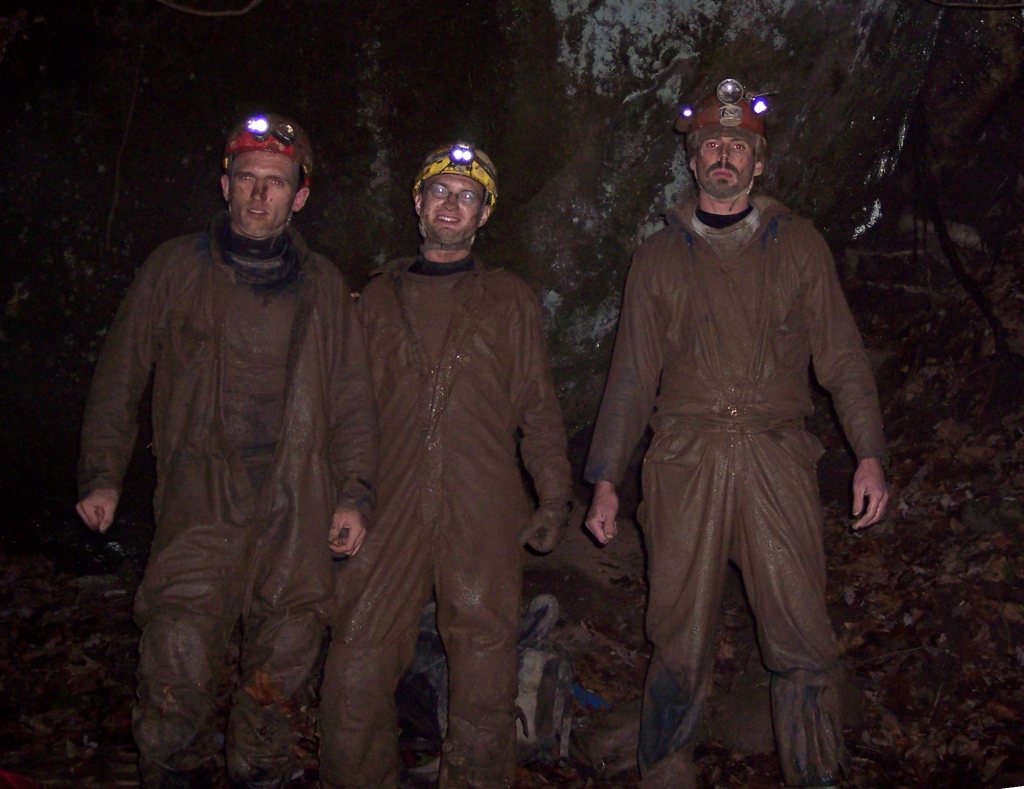
Dedicated team of diggers and surveyers, who traveled from as far as Ohio, Baltimore, or Michigan for a taste of sweet Cheat Canyon caving. L-R: Doug McCarty, Aaron Bird, Bob Kirk, Sandy ?, Greg Springer, Dave Riggs, Terry McClanathan and Brian Masney. Photo by Bob Kirk.

After several hours, enough progress was made on the dig so that everyone could fit through the squeeze. I started in and was informed that surveying had been nixed for the trip. I took Terry and Sandy for a tour of the cave, then Terry and I went out the Water Entrance to give him the "full taste" of a Cheat Canyon cave. We hiked down the hill and waded into the bath-water-warm Cheat River in full cave gear, washing everything off and staining the entire river brown. With zero feet surveyed, we hiked up to the vehicles and drove out of the canyon - despite lots of traffic on the Druid Road - for a Mexican dinner.

Saturday, June 23, 2007

[trip] Windy Slope Cave Dig

I did a podcast trip report from our digging trip into the newest significant cave in the Cheat Canyon, Windy Slope Cave. You can listen to the 15 minute report on PodCaver.

We got to explore the largest passage discovered in the Canyon since New Years Day Cave, and it goes for well over 1000 feet. Our digging efforts paid off - I was able to make the first ever through trip from the Fichtner entrance to the water entrance of Windy Slope Cave.

Link: Windy Slope Dig PodCast


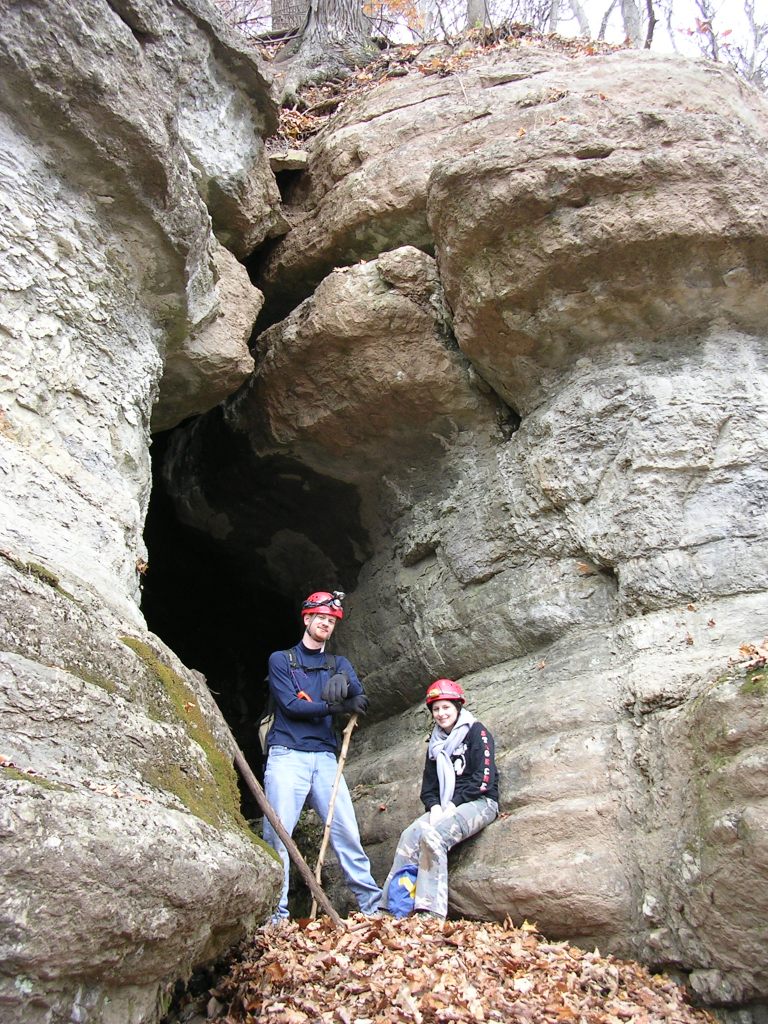
Dave Riggs, Brian Masney, and Doug McCarty in front of the Wet Entrance of Windy Slope Cave. Photo by John Harman.

Saturday, June 09, 2007

[trip] Cheat Canyon Work Week Day 2

Today was the second day of the Cheat Canyon work week. Aaron and Tristen Bird, Greg Springer, and I - Dave Riggs - met at Mark's at 9AM, then drove down the hill to his pond to unload camping gear. I was spending only a half-day in the canyon, while the others were camping and working the rest of the week.

At 10AM we hiked down the hill to Lick Run, where we spent the day poking and prodding in the hopes of finding and upstream entrance to Druid Cave. We located the bottom and the top of the Loyalhanna, and found several "interesting" spots, but no definitive places where water is pirated or holes with a vacuum to match the downstream blowing holes. The dye trace definitively says that Lick Run is the source of Druid's water, but we weren't able to find it today. I hiked up the hill at 4PM, everyone else planned on remaining to dig another hour and then call it a day.

Tomorrow the group surveys virgin walking passage in the newly found cave at the extreme downstream end of Druid Cave (past the Twin Springs). I won't be sending out any more trip reports from the work week, as I'll be spending the rest of the week in Mammoth Cave!

Work Week Stats
Surveyed Cave: 96'
New Caves: 1
Virgin Cave: 110'
Participants: 5
Person Hours Worked: 57
Liters of Mountain Dew: 6?

Friday, June 08, 2007

[trip] Cheat Canyon Work Week Day 1

Today was the first day of the Cheat Canyon work week, and it's already been productive. We met around 9am at IHOP for breakfast, and were greeted with an inspiring phone call from Allen Peterson. Allen's luck for finding cave in the canyon has apparently rubbed off on us (yes, bad luck is communicable). We arrived at Mark's farm by 10:30, and Brian drove us down into the canyon by 11am. From here, we split into two teams.

Aaron and Tristen Bird, Greg Springer, and Doug McCarty headed to the new cave above the Twin Springs with the goal of enlarging the blowing lead. The cave has now been named Fichtner Cave, in honor of a great landowner who has really helped us to make progress in the canyon. Edit: The cave became the Fichtner Entrance to Windy Slope Cave.

Aaron and Doug modified some tight rock using a Hilti loaned from Rocky Parsons and the Shavers Mountain Survey - Doug preferring to create significant clearance with just a hammer. They say that just a few feet of easily-scooped silt keeps them from reaching the room at the current end of the lead. Wind howls through this passage and room.

Meanwhile, Greg walked down the hill to river level, headed upstream for less than 100 yards, and hiked up a small gully which seemed to be blowing a slight cool breeze. About 50 feet up - perhaps 10 feet lower in elevation than the nearby Fichtner Cave entrance - he pulled up a rock and was hit with a "geyser of cold air". He and Aaron dug a bit and were soon looking down the barrel of more virgin cave! Aaron crawled in the entrance hole, turned towards Fichtner Cave, and was standing in a pool in walking passage. The passage ranges from 4 to 6 feet high, 1.5 to 3 feet wide, and is completely full of water - waist-deep at its deepest. He scooped about 60 feet to verify that it goes (it goes!) and headed back out, soaked and slimed. This cave also blows cold air with serious velocity, and it is suspected to be a lower level (and second entrance) of the nearby Fichtner Cave. The gully had been inspected by everyone at one point in the past, and had previously been flowing with considerable water, but was nearly dry today. This cave will be surveyed on Sunday.

While the other group was popping rocks and scooping virgin cave, Brian and I - Dave Riggs - went to push and survey the new cave that was dug open with Allen Peterson earlier this week. Allen has aptly named the cave Original Sin Cave, because finding and digging on this karst spring in 1980 was "The Original Sin" which has doomed generations of Northern WV cavers to spend an eternity in hellish Cheat Canyon caves. Dressed only in wetsuits, kneepads, knee-high rubber boots and helmets, Brian and I became known for the day as the "Extreme Team".

I headed into the cave first, and immediately noted that the entrance pool - dubbed by us "The Hot Tub" - was much lower than it was on Monday, excellent news! We both pushed our way back into the cave to the tighter spot where I'd previously turned back. A few rocks were moved, and I was beyond and caving in soggy virgin passage again... at least, for a few tens of feet. About 100 feet in, the cave stream comes in from a parallel side passage on the right; a ledge here provides only about 7 inches of crawl space to get past. It appears that if some cemented rocks were hammered from the floor, a small caver could push beyond and follow the water upstream where it appears to open up slightly more. The passage that we were in was never more than 2 feet tall or 3 feet wide, and we were constantly in icy water. There were a few small stalactites on the ceiling, however.


Dave Riggs in monotonous 18-inch-high stream passage, Original Sin Cave, Preston County WV. The stream is perched on a layer of black shale, visible at the bottom of the cave walls. Photo by Brian Masney

We headed out to warm up and eat, then did a bit of surface examination now that we knew what the cave inside did (but found nothing but sandstone talus on the canyon wall). We then surveyed the cave - a painful effort with a two-man team laying in an icy stream in 18 inch high passage. On the way out, we noted that the Hot Tub was very noticeably deeper than it was in the morning, and we suspect that this cave may flood to the ceiling at times.

Then, almost instantly, the sky turned grey and rain poured from above. We radioed the other group, who shared their news of another new cave, and headed across the canyon to see. We arrived as they were packing up, rain still coming down. Brian drove us back to Mark's house by 6pm, where the thunderstorm raged. Not wanting to camp in the rain, everyone decided to sleep in Morgantown for the night. We meet again tomorrow morning, 9am at Mark's house.

Work Week Stats
Surveyed Cave: 96'
New Caves: 1
Virgin Cave: 110'
Participants: 5
Person Hours Worked: 30
Beers Consumed: zero!

Monday, June 04, 2007

[trip] More Virgin Cave in the Cheat Canyon

Nearly 30 years ago, Allen Peterson and his band of "druids" did some ridge walking on the South side of the Cheat River canyon and discovered an interesting karst spring below an old logging road. They very briefly dug on the spring before following its water downhill, leading to the discovery of Druid Cave. As Druid grew over the years to 2.3 miles in length, the spring above its entrance was forgotten... until dye tracing in 2007 showed that this spring plays a very interesting hydrological role in the Druid Cave system: it appears to be the downstream resurgence of New Years Day Cave, which appears to be hydrologically distinct from Druid Cave until this spring water flows into the Druid Cave entrance on the surface.

Today, Brian Masney and I met up with Allen Peterson and revisited this karst spring for the first time since the discovery of Druid Cave. Allen, in the area for a business trip, met me at the Pittsburgh airport and drove us down to Morgantown. After meeting up with Brian, shuttling vehicles around, and fighting with car problems, we were off to Masontown and started hiking down into the canyon at around 2:30pm.

On arrival, we immediately started digging in to the spring, which fanned out both horizontally and vertically along the hillside below a limestone headwall. I prodded at a small conduit with a crowbar, while Brian and Allen poked around some large moss-covered breakdown with water flowing from within. Allen moved several rocks aside and felt a strong, cool breeze - paydirt! We went at the area with our hand tools and found that this part of the hillside was completely composed of breakdown blocks, small rocks, and easily movable fill. Over the next several hours, we easily moved close to a ton of rock - exposing more airflow and a cave stream, and destabilizing some of the sketchier rocks on the hillside.

The cave passage visible inside was low and very wet; working conditions required sliding downhill and pulling rocks out while someone else tugged you out by your own boots. We spent some time stabilizing the lining rocks and removing most of the entrance slope. The only remaining barrier was the icy-cold soaking in very low, unknown passage. We all took turns trying to push the nasty entrance, but none of us made it on first attempt. Brian and I played rock paper scissors, and I lost, so I took a deep breath and scooped some nasty, wet, virgin cave.


Dave Riggs emerges soaked from the low, wet, newly dug cave above Druid Cave. Photo by Brian Masney.

The entrance pool is a six foot wide chamber where the swiftly-moving cave stream is between two and six inches deep, and air space is one foot at the highest point. A wetsuit is needed from the very start, as the water is extremely cold and one is entirely soaked immediately.

Following the cave stream to the right, one travels parallel to the Cheat River, and distinctly up-dip in a nearly-straight line. The cave passage is never more than three feet high or wide, and is a semi-circular arching stream passage. The cave stream, while only an inch or two deep, takes up the entirety of the width of the passage in most spots, and is perched on a layer of etched black shale. I continued for what seemed like seventy-five feet, until the cave passage became small enough that I'd have had to exert real effort to continue, but the airflow and water ensure more cave beyond - so long as one has a wetsuit.


Brian Masney, Dave Riggs, and Allen Peterson at the newly dug cave entrance above Druid Cave. Photo by Brian Masney.

After all these years, the very first karst feature discovered by Druid Cave explorers finally yields virgin cave to one of its original discoverers. The dye tracing results show that this new cave should be the hydrological downstream resurgence to New Years Day Cave, and the fact that it appears to be perched on a shale bed reinforces the implication that New Years Day Cave and Druid Cave are hydrologically distinct, parallel caves.

The Druid Cave saga continues...

Sunday, March 11, 2007

Cheat Canyon Dye Retrieval Pt. 2

Today John Tudek, Tom Lilly, and Dave Riggs hiked into the Cheat Canyon to pull dye traps and examine some interesting karst features along the way. We met at 10:30am in Morgantown, then drove out to the NYDC-area landowner's house. We immediately set out for what would be a beautiful day - "warm" temperatures in the high 40's, and not a single cloud in the sky all day. The sun had nearly melted all the snow in the canyon by midday.

We hiked down from his farm, then headed upstream all the way to the Downstream Dig, stopping only briefly for a few photos on the way. The cave itself was still iced shut, so we quickly retrieved and replaced the dye trap in the spring and moved on.


Tom and John examine Hanging Falls, upstream from the Downstream Dig.

The next stop was the twin springs at river level. When we finally arrived, the springs themselves were completely underwater and not visible from the shore. Unfortunately, the Cheat was much higher during the last two weeks - at least three feet higher than normal level, as evidenced by debris lodged in trees and shrubbery close to the shore. Among the debris were our two dye traps - one left up on the shoreline, one was tangled and hanging up in the trees! We retrieved and replaced the traps, this time tying rocks to the string to serve as anchors. Hopefully they were in the water when (if) the dye passed through the springs.


Dye trap suspended about three feet in the air after a flood event.

We also spent some time enlarging the sucking hole located about 30 feet above these springs. We made short work of several hundred pounds of fractured limestone, exposing a larger hole which still howls air into it. This hole may have some serious promise. We hope to return soon when the ground is less frozen and digging is easier.


The enlarged sucking hole with glove for scale.

We then made the long hike back out of the canyon, arriving at the rim of the gorge at 4:30pm. Now that all the dye traps have been collected, we're all waiting impatiently for the results - hopefully we'll prove a hydrological connection between New Years Day Cave and Druid Cave!

See also: more photos by Dave Riggs

Friday, March 09, 2007

[trip] Druid Cave Dye Retrieval

To take advantage of the 50-degree heatwave today, Brian Masney and I decided that we'd head into Druid Cave to recover the dye traps place there just two weeks ago. We met at about 2:30pm on Friday afternoon, then carpooled in Brian's truck to the Cheat Canyon. Morgantown was very recently hit with a sudden blast of snow, so we were worried about the amount remaining in the canyon despite the temporary warm temperatures.

Brian drove his truck down the start of the Druid road, and we slid down the entire length of the first hill - yikes! Brian hopped out, quickly installed chains on his front tires, then tested things out by running back up and down the hill - a huge improvement! Despite several inches of snow, he drove us all the way down to the cave without incident.

We geared up and made it to the Druid Cave entrance at about 4pm. We were "greeted" by an odd bat, who flew out the main entrance and did some laps around the area for a bit, before we'd even entered the cave. The two of us headed into the cave, rigged the main drop, and rappelled the first drop with the welcome help of a webbing etrier.

Not wanting to make an expedition of the trip, we wasted no time in moving through the cave. We barreled through the high & dry canyon passage, then rappelled the second drop. Both armed with foot ascenders, we made short work of the waterfall ascent (which did not seem to have increased in flow at all, even with a large amount of snow melt this week) and the climb-ups.

At the walking stream passage, Brian stayed behind to try and photograph the sleeping bats, while I headed forward to the Big Nasty to retrieve the dye traps. I made sure not to handle the dye traps themselves, but rather only the strings, and I individually double-bagged and labeled each one. They were hauled out of the cave in a hard plastic container. Like the previous waterfall, the Big Nasty did not appear to have a higher water level than it did two weeks prior.

The trip back out was business-like and without incident. Except for the "special" bat when we arrived, none of the others were disturbed by our visit. Amazingly, we managed to do the entire trip in just under 2.5 hours, catching a glimpse of daylight as we exited the cave. Brian hauled us back up and out of the canyon, and we were back in town and eating a great dinner at Black Bear by 8:15pm.

We plan to hike back into the canyon this Sunday to pull the rest of the dye traps and investigate some interesting new karst features that were discovered recently.

Wednesday, January 31, 2007

Ridge walking in the Cheat Canyon

On late Friday afternoon, Jan 19th, 2007, Brian Masney, Mary Schmidt and Dave Riggs went to the Cheat Canyon to do some ridge walking for the Druid/New Years Day Cave system. Dave Riggs has been analyzing the line plots between the Druid and New Years Day Cave systems and something does not look right. It shows the end of the New Years Day Caves and Druid Caves several hundred feet away from each other. We decided to do some ridge walking of our own to see if we could figure out where the problem was.

Brian drove his truck down the Druid Road and parked it right above the cave entrance. We went to the main Druid entrance and got an updated GPS coordinate of the cave entrance. We wanted to make sure that was not the issue. Later on, we found out that the new coordinate matched almost exactly with the original coordinate of the cave. We are also confident with the New Years Day Cave coordinate since it is placed correctly on the topo map.

We hiked across the mountain from the Druid entrance and followed the limestone outcrop. There is a side lead in Druid that has less than a mile of passage in it. Several years ago when Greg Springer and company surveyed the side lead, they found a dead end passage where roots were in the ceiling and some surface debris was nearby. Dave used his GIS program to calculate the GPS coordinate of that location. We hiked around that area in the limestone but we did not find anything interesting. We didn't spend much time on that since that wouldn't help us get any closer to the deeper sections of Druid and New Years Day Caves.

Our next goal was to locate a spot where some surface water goes into New Years Day Cave. This is near the far back of the current survey and it was aptly named the Disney Ride by Dave Riggs. You have to crawl through a small slot near the ceiling where the water just pours onto you from the ceiling. Dave used his GIS program to determine where that should have been on the surface. We hiked to that coordinate and it was located in a stream bed with some water flowing in it. We followed the stream bed slightly downhill and we found a spot where all of the water disappeared underground. There was no viable place to dig. According to the GIS program, we would have to go down about 100' to get to New Years Day Cave.

After that, we hiked over towards New Years Day Cave. One of the GIS maps that Dave has is an elevation model of the state that was generated by a satellite. There is a depression in the main stream further downstream from New Years Day Cave. We wanted to check that out. There are a few waterfalls there and you can see some large cliffs on the other side of the hill. Unfortunately, they are on the opposite side of Lick Run compared to Druid. We did not have time to check these out since we had to be back in Morgantown.

Later that night, Dave looked at the data for New Years Day Cave and Druid Caves. Since we had an accurate elevation of the Druid Cave entrance, Dave was able to enter that data in his GIS program. The vertical line plots between the two caves are still in line with each other, with New Years Day Cave slightly higher than Druid. This is what we want.

The horizontal distance between the end of the two surveys is still pretty far off. New Years Day Cave has over 3,300' of surveyed passage and Druid Cave has 2.31 miles of surveyed passage. There are no loops to close and these are very long surveys. The likelihood of error in the two surveys is very high. A slight error in one survey shot would be compounded in later shots. With that in mind, Dave used the updated elevation of the Druid entrance to determine where the 3D cave passage should lie in the hillside. Our current data shows the end of Druid Cave sticking 70' out of the hillside. If the passage is moved to the left, then it shows the cave passage in the hillside where it should be. This puts it very close to New Years Day Cave.

This is good news. I hope that I have the same enthusiasm the next time I am surveying in New Years Day Cave. I am anxious to get back in there so that we can finish this project.

Wednesday, November 22, 2006

[trip] New Years Day Cave Survey

Ben Franklin is often attributed to saying:

"The definition of insanity is doing the same thing over and over and expecting different results."
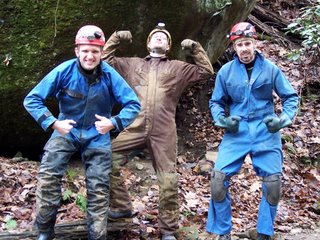


Brian Masney, Dave Riggs, and Jason Thomas are insane. On Saturday, Nov. 18, we headed back into New Years Day Cave again with the hopes of making the elusive connection with Druid Cave. Once again we hoped that this time would be different, and once again the cave got the best of us.

Druid Cave, with over 2.3 surveyed miles of crumbling, muddy passage, has a much-deserved reputation as one of the nastiest caves in West Virginia. In fact, some would consider it an evil cave. When the 8+ hour travel time for survey trips finally became too taxing, the Druid surveyors began looking for an upstream entrance to the cave to make their lives easier. What they found was New Years Day Cave, which has proven to be anything but easier. If Druid was the frying pan, NYDC is the fire.

The three of us met Saturday morning at the rim of the Cheat Canyon. We packed all our gear and started the hike down into the gorge. A weeklong rain had Lick Run roaring with more water than I'd ever seen it move. We suited up into wetsuits and our caving coveralls, packed extra fleece polypro underwear, heating pads, candles, and emergency gear. We not only prepared for the worst, we expected it.

We were in cave before 11am, and were relieved to find the cave stream in the first part of the cave to be at a reasonable level. We moved fast and tried our best to stay dry on the way in. Our goal was to reach some "large" paleo-passage discovered on the last survey trip, in the deepest depths of the cave, where NYDC is known to be at its closest point to Druid Cave. We stormed through the beach crawl, down through a horrible wet crawl, squeezed through the rock-on-rock, dropped down into the sawtooth-lined Whack-A-Mole™ Way, squirmed through Jason's wormhole, dragged ourselves across a wet bedding plane parting, and made our way into another horrible canyon passage. The black rock in this section of the cave will crumble without warning beneath an unsuspecting caver's feet. Water pours in from the ceiling onto your head while the passage meanders into such contortions that it seems to be trying to evade you.
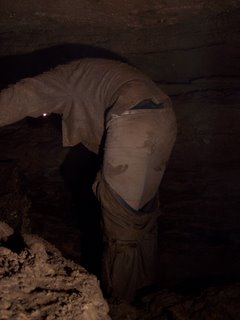

Jason's cave suit, literally shredded by the sawtooth walls before we'd even reached our destination.

After several hundred feet of this hellish passage, we climbed up to the ceiling and crawled through a very nondescript, nearly overlooked squeeze to a parallel passage with a decent-sized, dry, open room. I was amazed. Even more amazing was that this room led to hundreds and hundreds of feet of more dry, open, large passage! We had made our way into a parallel grid of joint-controlled passages, sometimes as wide as 20' with a 20' canyon incision. There were flowstone and drapery formations, the floors and walls were coated with a thin film of mud, but there was no moving water in sight. A cobble-lined stream bed lies in the canyon floor, and very large slabs of breakdown have tumbled down in places. Unfortunately, there was no air movement in this section. We pushed in the upstream direction until our first joint squeezed out, then followed a 90° connector over to the next parallel joint and pushed it for a bit, finding a 30' high dome and lots more mud. Still, no air.

We exited this beautiful passage and crawled back into our stream canyon to follow the air. At this point, the canyon follows the straight-line path and direction of its neighbor passages, as a part of this master joint set. The canyon tightens up, leaving a 12" by 18" tunnel up towards the ceiling, with 10' of narrow, terrifying canyon reaching down below. With no way to go at the bottom, the top was our only way forward. This crawl was certainly too narrow to turn around in, and the canyon below with the crumbling rock walls and floor made it especially dangerous.

I reluctantly volunteered to go in, on the condition that Brian follow me. We started in, pulling our bodies with our fingers and pushing with our toes. The canyon in the floor kept sucking in feet and kneepads, the passage was so narrow that I couldn't turn my head or put my arms back at my side. I crawled for perhaps 50' in the hopes of finding a slightly wider spot, but the passage maintained its torturous dimensions. I shined my StenLight forward and saw nothing but blackness far ahead -- if this passage parallels the larger joint-controlled passages to the side, it could stretch for hundreds and hundreds of feet. More than a bit spooked by the confinement and the thought that a rescue this deep into the cave would be nearly impossible, I decided that I would not go any further. We started the arduous task of backing out, pulling with toes and ankles, pushing with fingertips attached to helpless outstretched arms. It was a long, tiring haul back to passage of kneeling height.

Disappointed with this failure, we opted to survey for a bit in the large, dry passages. We took some time to eat and rest, changed into warmer clothes, and surveyed some nice long shots. Due to how physically exhausted we were, along with time constraints, we surveyed only about 250', leaving many hundreds of feet more to be surveyed and explored in this network of passages. These tall canyons could lead us to a more promising upper or lower level, or they could somehow bypass the nasty canyon crawl that kept us from following the Druid Winds.

On the way out, we no longer cared about trying to stay dry. We barreled out of the cave at record speed while the cave did its best to slow us down. We reached the surface one hour and forty-five brutal minutes later, but New Years Day Cave had the last laugh. The Druid Spirits were especially tough on Jason, his cave suit was literally ripped in half, StenLight was out, his carbide lamp working only in fits. My suit was torn in the shoulders, legs, and knees. All of us were physically beat, we were soaking wet and coated from head to toe with mud, and the temperature outside was in the upper 30°'s. We still had to hike up and out of the Cheat Canyon.
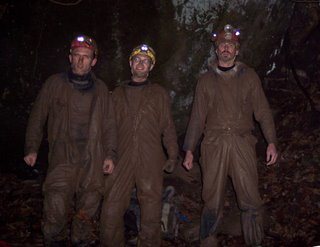


To say that the trip was exhausting would be an understatement. We were in cave for about 11 hours, New Years Day Cave time; this probably equates to days in "lesser" caves. The Druid connection eluded us again, NYDC proved to be every bit as horrid as it has in the past, and everyone involved was ready to swear off caving for good... but we know that next time will be different.

All photos by Brian Masney

Wednesday, November 08, 2006

Ridge Walking in the Cheat Canyon

Kyle McMillan, Gayle Suppa, and myself -- Dave Riggs -- did some ridge walking down in the Cheat Canyon on Election Day. We met at 10am at Coopers Rock, then hiked the trail out to Raven Rock. From there, we followed the power line cutaway straight down into the gorge. This canyon is incredibly steep! Though the forecast called for rain all day, we had a beautiful day with nothing more than a few sprinkles.

After somehow passing right over the limestone outcrop, we continued down to a sheer vertical drop just a few hundred feet from the river itself. We'd gone too far, and started hiking over to a stream falling over a sandstone shelter cave.


Gayle under the shelter cave. The stream flows down from Beaverhole Lower Cave.

We followed this stream straight up the hill and, as expected, found it to be the stream resurgence of Beaverhole Lower Cave. We spent about 45 minutes in Beaverhole Lower, traveling back in it's single straight-line passage until we were sufficiently bored. Some of the walls are polished smooth from all the caver traffic back in the 60's and 70's, as evidenced by the old signatures back there. Hard to believe that so many people made this brutal hike down for such a boring cave. If nothing else, the cave is interesting in that there are no side leads or tributaries, it's just a single passage extending at least 1300' straight into the mountain.


Kyle and Gayle at the entrance to Beaverhole Lower Cave

Then we followed the limestone outcrop, hoping to find something new and exciting. Travel was very slow as the terrain was extremely steep and slippery, at some points bordering on dangerous. We found a 40' high limestone cliff with a 2' - 4' diameter cave passage up in the cliff, but weren't able to safely get close enough to check it out. Vert gear will be required to investigate it.


Limestone cliff with small cave passage visible up towards the top/middle

We traveled a bit farther, just enough to spot a very large valley and an 80' tall waterfall over a limestone cliff in the distance. It's enough to make me want to brave the brutal hike through the canyon again to check it out. We were back to Morgantown by just after 4pm and had a well-deserved meal at IHOP. We then met the WVUSG at 5pm and I went with them to Beaverhole Upper.

See: My Photos

Monday, June 12, 2006

[trip] New Years Day Cave Survey

Aaron Bird, Brian Masney, Jason Thomas, and myself (Dave Riggs) made another trip back into New Years Day Cave this weekend (June 10). We first surveyed from the bedrock-on-bedrock crawl, through the Whack-A-Mole™ Way, to the last dig. We then broke up into two teams, and together surveyed through Jason's wormhole, past the dome, past the low/wide stuff, and into the crumbly canyon passage that we last turned around in.

We were in cave about 9 hours and surveyed about 1010', which brings New Years Day Cave to a whopping 2499' length - now the longest cave in Monongalia County (topping Maiden Run Cave #1 at 1800')!


Amazingly, we do this for fun.


The line plot shows NYDC heading directly for the end of Druid Cave, with about 400' straight-line distance between their surveys. We turned around in canyon passage that requires a hammer to continue forward, and the Druid wind is still very strong in this far end of the cave.

Photo by Brian Masney

Wednesday, May 17, 2006

[trip] New Years Day Cave Push

This past Saturday, May 13, Brian Masney, Jason Thomas, Bob Kirk, and myself (Dave Riggs) made another trek into New Years Day Cave. NYDC is believed to be the still-unconnected upstream trunk of Druid Cave. The goal of this push trip was to get past a boulder blocking further progress into the cave - Bob had helped us past similar obstacles at the downstream dig, and was making his first trip into NYDC to help us continue forward.

We met in Morgantown around 9am, drove up to the lip of the Cheat Canyon, and started the trek downhill. All four of us suited up in wetsuits with warm layers over top, carried spare layers sealed up in dry packs, and packed in hand warmers, candles, and a heat tent. Armed for battle with a brutal cave, we headed underground at just after 10:30am.


Brian Masney, Dave Riggs, Jason Thomas, Bob Kirk prepare for another relaxing day in New Years Day Cave

Luck seemed to be with us; the water level was low and the moderate temperature outside meant that the cave air was relatively still. Because we were able to stay dry, we actually had to stop and cool off halfway through the sandy "beach" crawl - a wide silt stream bank with a very low ceiling. Everyone was soon soaked after trekking through the cave stream and going headfirst down into a much-loathed water crawl. From here, we did a short jog through the Mon County Borehole and made it to the rock-on-rock-slab crawl at the end of the current survey.

We went ahead and to the Whack-A-Mole™ passage, so named because the finger-like protruding shelves needed whacked with a hammer to comfortably walk through. This was my first time past the last survey station, and I was honestly impressed with the size, the speed we were able to travel, and the distance that this passage covers. For New Years Day Cave, being able to stand upright and walk forward for more than a hundred feet is a welcome treat. I expect the next survey trip to add a good bit of distance because of this passage. Notable here was a large number of shell fossils embedded in several of the limestone beds along the walls.

Finally, after close to two hours(?), we reached our destination: a narrow trench going down from an upper passage to the stream level below, blocked at the very bottom by a boulder just barely larger than the opening it guarded. Jason, Bob, and I started to work on it immediately. Jason and I each drilled a hole, but progress was slow. The passage was apparently blocked with the only sandstone boulder in the entire limestone cave - it would quickly crumble and fill any hole we drilled, while the edges would crumble under the pressure. Meanwhile, Brian suited up, grabbed a shovel, and pushed a parallel lower path in the stream. He made it forward almost to where our boulder was, but was obstructed by more breakdown.

After unsuccessfully trying to tug the boulder out of the way with webbing, it was decided that our best bet against the unwilling rock was to simply pulverize it with the hammer. We easily rounded all the corners, but it was extremely difficult to swing powerful blows in the bottom of the 18" wide slot - progress was again slow. In addition, we were very weary of some sketchy breakdown seemingly balanced on the rocks adjacent to our sandstone foe. We took turns pounding on it, gradually chipping it smaller and smaller, and keeping us from becoming too chilled.

Near 4:30pm we succeeded in rolling the deflated boulder out of the way, leaving a huge mound of powdered rock behind in its place. I squeezed through the opening, being careful not to touch the breakdown on my side, and crawled forward in the stream passage. I shouted back, "It goes... but it sucks!". I went about a body length in and could see that the tunnel shrunk up ahead to painful proportions, with no visible place to turn around. Worse still was the backside view of the sketchy breakdown... the protruding bottom rock itself appeared to be held in place just by the weight of the piles of rock above it. I squirmed out and Jason popped in to confirm that this was at best an obstacle to tackle another day, and given how unstable the adjacent wall seemed, could at worst be the end of the line for New Years Day Cave.

Everyone huddled up above to discuss the situation. Frustrated that this nasty cave could defeat us after all the trips in and out over the past two years, Jason decided to prove to NYDC who was in charge. He went head-first into the sketchy upper "passage", a pile of breakdown supported by breakdown with a roof made of... breakdown. He started pushing and shoving rocks aside, and inching his way forward - head-first, downhill, without room to turn himself around. And after at least 15 grueling minutes of this...


Jason Thomas triumphs over NYDC


...Jason had broken into a virgin room.

We clamored one after one through his wormhole, each of us prying or tossing aside a rock or three so we could fit. The room is about a dozen feet tall, one side frighteningly walled by a mudslide. You drop down to stream level, follow the stream forward a bit and the ceiling becomes lower, to stoop height. A dome, 15 - 20' high awaits, with the first real formation I've seen in New Years Day Cave. From here the stream meanders a bit, the ceiling gets lower and lower, the passage gets very very wide - probably 40' at its widest width, 2.5' at its lowest height.

A couple-hundred feet in, there is a boulder intersection, which we went around and followed the wind down a crawl. Here the passage becomes very different - fingery canyon passage, narrow but 6 - 8' tall, meandering with the water. The "limestone" has a black coating and the fingers can be easily broken off, as if composed of some rotten mud-rock. The Druid winds continued, but we turned back to save the booty for another survey trip.


Jason in the virgin canyon passage, note the rotten limestone walls

The trip back out was exhausting. The pointed shelves in the Whack-A-Mole™ passage are shaped such that they poke and grab at every piece of your suit and pack on the way out. We were all coated with sandy mud, and our packs were filled with gear (Bob measured his with a fishing scale afterwards - 50lbs). We finally exited, before dark, scrubbed ourselves off in Lick Run, then hiked back up the brutal hill with mixed emotions. Brian summed everyone's feelings up by saying "Jason, I don't know whether to hug you or kick you!"

Photos by Brian Masney

Sunday, January 01, 2006

[trip] Virgin Druid on New Years Eve!

Saturday, New Years Eve 2005, just 364 days after virgin cave was entered at New Years Day Cave, I got the honor of breaking into virgin cave (my first ever) at the downstream dig! The new cave (edit: officially named "Hero Hole") is obstructed upstream after about 200', but considering the strong wind and the much better limestone than the upstream (NYDC) side, we know there's lots more cave to find. This cave, and New Years Day Cave, are presumed to be the downstream and upstream arms of Druid Cave.


Aaron, smiling at another successful speleo-project - photo by Brian Masney

Sunday, November 13, 2005

How Druid Cave Got Its Name

I asked Alan Peterson how Druid Cave got its name... He was president of the WVU Student Grotto back in 1979. They spent lots of time in Beaverhole Upper and Lower, Maiden Run, and figured that there must be some caves that lined up with them on the other side of the Cheat. They consulted some topo maps, and started doing ridge walking in probable locations. The group of 3 that found the Druid entrance were all Forestry majors. Since "all Forestry majors worship the trees", they decided that there was no better name for it than "Druid".

Prior to this weekend, he hadn't been back in a cave since they found Druid, 25 years ago - it'll probably be another 25 years after NYDC!

[Trip] NYDC Work Weekend

This Saturday was a "work weekend" at New Years Day Cave. A record 8 victims volunteers met up at Aaron Bird's house at 9:30am. I almost missed the caravan due to an unwelcome speeding ticket, but made it just in time.

My team - me, Aaron Bird, Doug McCarty, and one of the original discoverers on Druid Cave, Alan Peterson - spent the day continuing the survey. We started the survey just on the other side of the nasty water crawl. We added about 300' to the survey, to just past the long rock-on-rock crawl (which was about an inch smaller than Doug in his wetsuit). A summarizing quote from this survey trip was "David, the next station is this hole in the mud."

We used glowsticks for this survey, and I'm impressed with how well they worked out. The forward and back sight each had a different color so you could use your stick (eg. orange) to light the instruments while easily sighting the other color stick (eg. green). Since they're a line instead of a point, you can align the stick vertically for sighting azimuth and horizontally for sighting inclination. Very handy, but avoid trying to use a dim one!

The other team - Brian Masney, Jason Thomas, Rocky Parsons, and Alan Grubb - went ahead with the intent of pushing the cave towards Druid. They put a good deal of muscle power against some formidable rocks, and weren't able to pass.

The hike up out of the valley was slow and painful for everyone! Afterwards, everyone headed back to Aaron's where Rachel had prepared some awesome bean soup and blue cornbread.